
How to Get Rid of Mould in Your Calgary Home: A Complete Guide

Mould in your home goes beyond just a pesky stain or smell. With large variations in temperature, snow, ice, plumbing issues, basement dampness, condensation, and poor ventilation, Calgary is home to a myriad of possible causes for home mould growth. Mould growing around windows, bathrooms, basement, ceiling, drywall, and other damp places in your home can be dangerous and should not be ignored as it spreads and affects the wellbeing of your family. The best way to get rid of mould in Calgary is to not only deal with what can be seen, but also to find where the moisture was coming from, which encouraged it to grow. What Causes Mould in Calgary? Mould will grow on surfaces where there are high levels of moisture. Possible sources for this are plumbing leaks, roof leaks, water, condensation around windows, humidity levels, foundation dampness, and poor bathroom or basement ventilation. Calgary’s climate can also encourage mould growth on the foundation of a home due to snow and ice buildup, and on cold areas like windows due to high levels of indoor condensation. Health Canada recommends indoor humidity levels be kept between 30 and 50% and that any moisture problems be dealt with immediately. How to Get Rid of Mould in Your Home? The first step in removing mould is finding the source of the moisture that encouraged it to grow. This can be plumbing leaks, moisture in drywall, condensation, water stains, wet carpet, faulty seals, or another cause. In the case of a small amount of mould growth with a clearly defined source on a non-porous surface that can be cleaned, homeowners can get rid of the minor infestation themselves, with caution. Health Canada recommends that homeowners do not use bleach to remove small amounts of mould. Mould that occurs on drywall, insulation, carpet, or other porous materials is much harder to get rid of due to the mould being underneath the surface and needing the material replaced. Painting over mould growth is not an advised solution as it does not eliminate the source of the moisture, and recurring mould means the source has not been properly addressed. When Should You Call a Professional Mould Removal Company? Although some small infestations can be dealt with by homeowners, there are many instances in which a professional mould removal company is needed. The size of the infestation and how obvious the source of moisture is are two of the main factors to consider when deciding if a professional mould remediation company should be contacted. According to Health Canada, any infestation larger than 3 square metres should be dealt with by a professional mould removal company. Additionally, recurrent mould should also be dealt with by professionals even if the source of moisture can be addressed as mould that recurs is dangerous and its presence should be eliminated. It is also advisable to call a professional mould removal company if the source of the infestation is not obvious, or if there is moisture behind walls or other places where the visible mould has already been removed. This is especially true if there has been a large amount of water or moisture in the area, such as in the case of basement flooding, plumbing issues, roof leaks, or another large-scale moisture problem. Mould remediation and restoration companies can also help in cases where there has been significant water damage with moisture lingering long after the water has been removed. Mould Removal and Moisture Control Go Together A competent mold remediation and restoration company will be able to deal with both the issue of the mould and the source of the moisture that caused it. This can involve: Health Canada notes that it is possible for mould to begin growing within hours of water damage or another source of moisture. As such, any water damage or leaking problems should be dealt with immediately so that mould does not have a chance to grow in the first place. Why Choose HazPro Restoration for Mould Removal in Calgary? Large-scale infestations, recurring mould, and moisture or water damage that leads to mould growth need to be dealt with much more seriously than a simple do-it-yourself job of removing a minor infestation. HazPro Restoration offers professional assistance to Calgary residents dealing with these issues. We can help determine the source of the infestation and the steps needed to not only get rid of the mould but to ensure it does not return. Whether the owner is dealing with a minor or recurring infestation, HazPro Restoration can advise them on the best way to deal with the problem, including what steps can be taken themselves, what needs to be addressed by a professional, and what should be done to ensure the issue does not occur again. If you have seen signs of water damage or noticed signs of mould in your Calgary home, it is important not to hesitate in getting rid of it. Contact HazPro Restoration and ask about our professional mould removal and moisture management services. Also Read: Mold Testing in Airdrie Frequently Asked Questions About Mould Removal What removes mould permanently? Unfortunately there is nothing that can truly remove mould completely from surfaces. The most crucial step in dealing with mould is dealing with the source of its growth. Leaving a leak, humidity problem, condensation, or poor ventilation will encourage new mould growth. For larger infestations professional help can advise on the best way to get rid of the mould and prevent its return. HazPro Restoration can inspect the issue and recommend the best course of action, including any steps for dealing with moisture issues that may be present. How do I remove mould myself? A small patch of surface mould can be dealt with using soap and water, along with the proper safety precautions. According to Health Canada, this includes wearing eye protection, gloves, and a disposable N95 mask while removing the mould. DIY mould removal is not recommended for large infestations, on porous surfaces, for hidden mould,
Mold Remediation: What Calgary Homeowners Should Know About Mold Removal
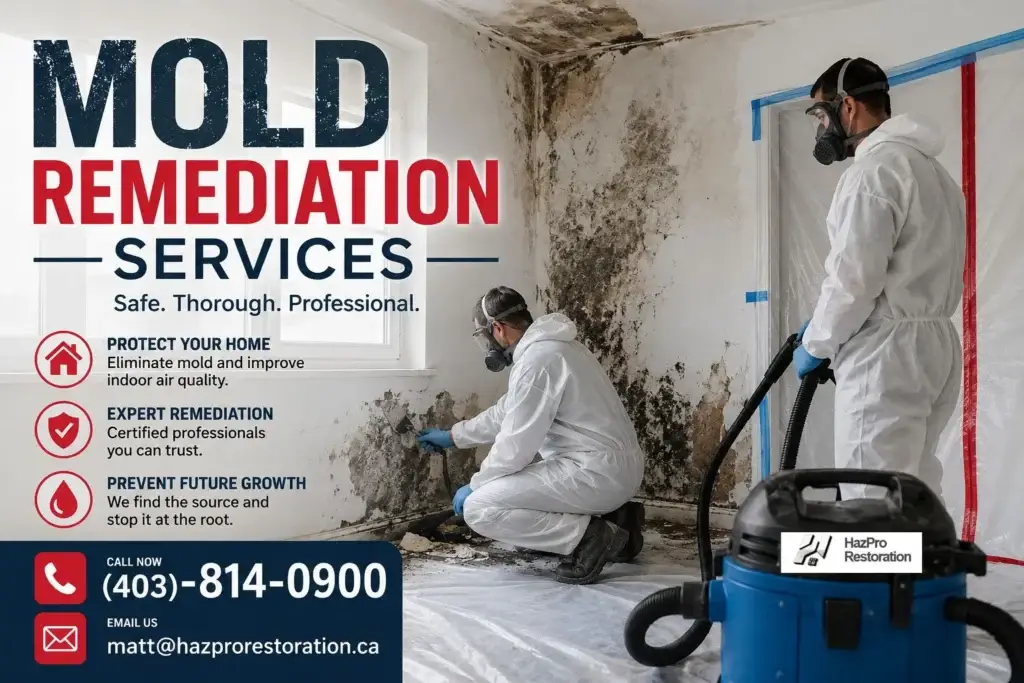
Mold can be a sneaky type of problem, and while it may be lurking in your home, it won’t be one if you have it addressed. Things like leaks and floods, condensation, poor ventilation, and high humidity can lead to mold growing inside your house. If you can smell it, see it, or feel that it’s around it’s time to stop hiding behind the mask and deal with it. Professional mold remediation services can take care of not only the mold itself, but the underlying issue that allowed it to begin growing in the first place, which Health Canada recommends as being vital to a proper restoration, as otherwise, simply removing the mold may be doing little to stop it. What is Mold Remediation? Mold remediation refers to taking care of an issue with regards to mold, including things such as the underlying causes, the removal of the mold itself, and the cleaning of the area to ensure that it doesn’t return. While simply removing the mold you see may seem like enough, there may be other points of concern that could be contributing that you’re simply not aware of, including other areas of mold that may not be directly apparent such as inside the walls or ceiling, or even an odd smell that has no obvious source. When Should You Hire Professionals While small spots on hard surfaces may be cleanable, more serious mold problems, frequent mold issues, water damage, or other concerns may require a professional remediation service According to Health Canada, professional mold remediation services should be contacted for cases with clearly visible large mold infestations that are greater than 3 square meters as they’re able to properly clean the mold off the surface and check for any underlying issues, and also if the mold keeps coming back or has gotten into the walls, ceilings, or floors. With a mold remediation professional, they’re able to handle the problem correctly rather than simply cleaning what you can see. (Canada) Mold Removal vs Mold Remediation Looking at the terms ‘mold removal’ and ‘mold remediation’, you may notice the slight variation in terms, but they largely refer to the same thing. While mold removal refers more to physically getting rid of the mold, remediation refers more to tackling the underlying causes in addition to physically removing it. The same goes for the British counterparts of these terms, which are spelled ‘mould removal’ and ‘mould remediation’. When looking at either term, it’s important to understand that while simply physically removing the mold is part of the equation, it shouldn’t be the full plan of action because there are likely a number of underlying problems that need to be addressed before this can be considered truly remediated. Why a Mold Inspection in Calgary Can Help While simply looking around may seem enough, there may be some things you’re simply not able to see, even if you know what to look for. Looking in places that are commonly associated with moisture is a good place to start, including things such as bathrooms, basements, areas around windows, on pipes, on ceilings, or any other area that may have seen leakage or other water damage in the past. When it comes to looking for mold inspection Calgary services, it’s important to note that those that offer both a moisture inventory assessment and a visual inspection are best, as Health Canada advises that taking an air-sample test isn’t actually recommended for checking for indoor mold as it’s unnecessary, and it’s better to pay attention to things such as visible mold growth and any areas of concern that may have moisture. Can I Do My Own Mold Remediation? For smaller spots of mold, it’s possible that it’s something you can clean yourself, provided that you pay attention to any precautions that should be taken to ensure that it doesn’t come back. According to Health Canada, small or even some medium mold infestations can be cleaned by yourself, provided that you know what you’re doing when it comes to cleaning it. Larger mold growths, recurring mold problems, mold that you can’t actually see, and any water damage situations are best left to the professionals, however. If you’re unsure of the extent of a mold issue you’re facing, it’s always better to contact a professional remediation service. What are the Signs of Mold Sickness Mold can generally cause things such as irritation to the eyes, nose, and throat; coughing and wheezing; shortness of breath, allergic reactions, and increased asthma symptoms, among other things, but it’s generally not the sole culprit for these issues, and if you feel that you could be suffering from mold poisoning, it’s best to consult a medical professional about it. Can Mold be Remediated? When asking if a mold problem can be adequately addressed, it’s important to remember that while a full remediation of a mold infection is possible, there will still always be some mold spores in the air both indoors and outdoors. The point of a mold remediation is to get rid of any visible mold infections and address any moisture damage, while also ensuring that the conditions that caused them aren’t present anymore, as otherwise, it’s likely to come back. (US EPA) What are the 10 signs of mold toxicity? While on the internet, you may have come across the concept of ‘mold toxicity’, it’s important to be careful when it comes to any symptoms you may or may not be experiencing, as not every symptom that’s been tied to mold toxicity has actually been proven to be a result of it. With that being said, indoor molds have been proven to cause a number of issues, including things such as: These symptoms should be discussed with a medical professional if you feel they could be applicable to your case, but always leave diagnosing to the professionals. Also Read: Mold Removal in Calgary Protect Your Home with Professional Mold Remediation Services How to Prevent Mold From Coming Back Now that you’ve