
Mould Removal Calgary | Remediation & Testing Services
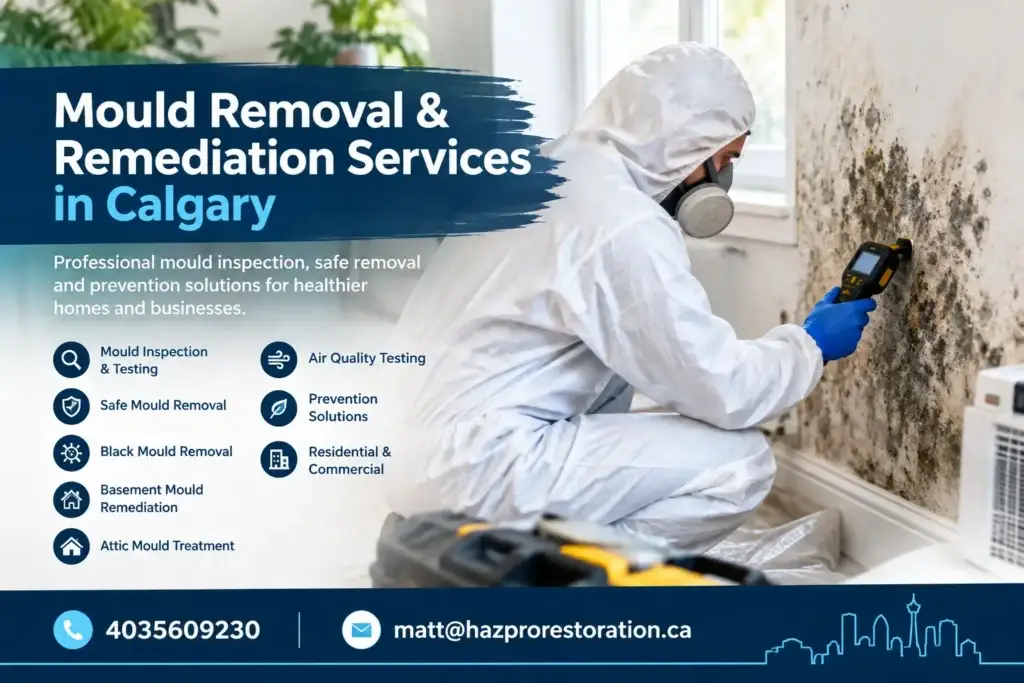
Moisture, condensation, water damage, leaks and poor ventilation can result in the growth of mould. These causes can be common in Calgary properties such as basement moisture, water damage, bathroom humidity, roof leaks and foundation leakage. Our expert teams are specialist in all aspects of mould remediation services in Calgary for residential and commercial properties in all quadrants of the city. Mould Inspection & Testing Services Calgary Determining the causes and extent of mould infestations that have occurred is an important preliminary step to remediation. As a part of our extensive mold removal services in Calgary, we offer a professional mould inspection to ascertain the extent of infestation and identify affected areas. An inspection may be required if there are signs of mold – i.e., musty odours, water stains, peeling paints, warped surfaces, visible growths, and heightened allergy complaints. How We Remove Mould From Properties in Calgary? Once the causes and affected regions have been identified, containment and removal procedures can be undertaken. Our expert technicians perform the entire mould remediation in Calgary using containment measures, HEPA filtration and appropriate removal techniques to ensure that the infestation is entirely eliminated. Our typical remediation process consists of: – Initial consultation and inspection – Mould testing and assessment – Containment and HEPA filtration – Mould removal procedure – Prevention measures and verification testing Types of Mould Removal Services Calgary Black Mould Removal Black mould, including that of Stachybotrys, requires appropriate specialist removal measures. Our certified technicians offer black mould removal procedures for residential and commercial properties in Calgary. Basement Mould Remediation Calgary basements are highly susceptible to mould growths due to moisture and flooding. As a part of our comprehensive mould removal services in Calgary, we offer basement mould remediation to eliminate infestations and prevent them from returning. Attic Mould Treatment Mould growths in attics are commonly caused by poor ventilation or roof leaks. Professional attic mould remediation procedures can be carried out to remove infestations and identify the contributing moisture factors. Air Quality Testing Air quality testing and mould spore testing can be performed to confirm that infestation levels are back to normal after remediation. Mould Prevention Measures for Calgary Properties In addition to the removal measures, there are also prevention methods that are essential in ensuring the infestation does not return. There are several common factors that can lead to mould growths in residential and commercial properties including basement moisture and flooding, poor ventilation, water damage, window condensation, foundation moisture, bathroom humidity and roof leaks. Our technicians can implement prevention measures specifically for Calgary properties. Also Read: How to Get Rid of Mould in Your Calgary Home: A Complete Guide FAQs – Mould Removal Calgary How Quickly Can You Respond to Mould Concerns? HazPro Restoration provide professional mould inspection and remediation services for residential and commercial properties in Calgary. Contact our team to discuss your requirements and arrange an initial inspection. Do You Offer Mould Prevention Advice? Prevention is a vital component of our remediation services in Calgary. We can identify the causes of infestation and implement measures to prevent it from returning. How Long Does Mould Remediation Take? The document does not specify a standard remediation time scale. Factors that affect the length of the process include the findings of the initial survey and the extent of the infestation. Can I Remove Mould Myself? The document does not specify DIY mould removal measures. For extensive infestations or hazardous mould types, professional assessment and remediation is recommended to ensure that the problem is completely eradicated Is Black Mould Dangerous? Black mould, including that of Stachybotrys, should be removed by specialist technicians. Our qualified teams offer comprehensive black mould removal services in Calgary. How Do You Test for Mould in Homes? We carry out a variety of mould testing procedures, including moisture meter readings, thermal imaging and air quality testing to assess mould infestation. What Causes Mould to Grow? Moisture is a common cause of mould infestation. Factors that contribute to excess property moisture in Calgary properties include basement flooding and moisture, poor ventilation, water damage, condensation, foundation leakage, bathroom humidity and roof leaks. Can Mould Return Following Remediation? Mould recurrence is possible if the initial infestation sources are not completely eliminated. Thus, it is important to treat leaks, condensation, poor ventilation and other moisture sources. Do You Remove Mould from HVAC Ducts? The document lists HVAC mould removal as a frequently asked question but does not offer specific mention of HVAC remediation services. How Much Does It Cost to Have Mould Removed in Airdrie? The document mentions this query but does not specify a cost for mould removal in Airdrie. A full assessment is required to determine the extent of the job and associated requirements.
Black Mould in Calgary Homes: Causes, Signs, and What to Do

Black mould, for any homeowner, is a terrifying sight. Spots of it on a basement floor or wall, bathroom, ceiling, or on a wall can leave you wondering what to do. Calgary residences are exposed to moisture from leaks, condensation, flooding, and wet spots due to poor ventilation or dampness in walls or ceilings that encourage mould growth. When black mould occurs, moisture must be removed, and experts should be notified to make certain that black mould removal will take place before the issue becomes worse. HazPro Restoration offers its professional services to help restore your property by providing expert mould removal and remediation, locating and eliminating sources of moisture, and treating all mold-infested surfaces. What Is Black Mould? “Black mould” is a general and often misused term that refers to any mould that has a colour similar to the hue of the inside of a black marker. While there is a specific type of mould called “black mould,” there are other types that can look black, or appear black and must be evaluated to know what type it is. Mould flourishes in moistures and can begin growing where there are damp spots, or materials have absorbed moisture and are still damp. Mould grows on drywall, wood, carpeting, ceiling tiles, insulation, and other porous or absorbent materials. Since black mould often grows in areas that are not easily examined, visible signs may indicate a far greater infestation of black mould, with multiple hotspots. Sources of Black Mould Moisture causes mould to grow and spread in your home. Many homeowners dealing with mould problems in Calgary often wonder what causes black mould and how they can avoid it. The most general causes of moisture in a home are: 1. Leaking Pipes or Water Appliances A leak that runs for days or weeks can leave your basement or cabinets damp and moist due to the presence of water and can encourage black mould growth. You may observe a faint stream of water from the back of a cabinet in the kitchen or in the bathroom. 2. Wet Basements They can invite a variety of household bugs and are a home infestation or invasion risk. Basements are often cool, damp, and dark, which is an environment that mould and bugs thrive in. 3. Overflows or Flooding Floods are common in Calgary and are a leading cause of many home mould problems. Removing moisture, debris, and other contaminated matter from flooded areas such as basements or bathrooms in your home is critical. It is important, for instance, to dry wet carpets, rugs, or any item that has absorbed moisture. The faster the better, to avoid moisture being trapped in your home. 4. Condensation Warm, moist air meeting cold surfaces like windows or outside walls forms condensation that can leave wet spots on your walls, windows, and even pipes. Warm water pipes, for instance, may form moist spots on cold surfaces such as concrete walls, leading to condensation that can encourage blue mould growth. 5. Poor Ventilation It is important to ensure that your home has adequate ventilation, especially bathrooms and kitchens. When air can’t circulate, it leaves wet spots on surfaces. Symptoms of Black Mould in Residences While any growth of black spots on your walls is an obvious sign of mould, other symptoms may indicate the presence of black mould. Some of these symptoms include: • Black mould patches or streaks on walls, ceilings, and/or floors • Unpleasant odours • Discoloured areas • Damp smells • Mold recurring after its removal • Peeling paint or wallpaper • Swelling drywall • Flooding or leaks • Visible dampness, especially on windows, around pipes, or in basements A musty or foul odour combined with other signs is usually an indicator of black mould growth, even if it isn’t readily apparent. Locations That Encourage Black Mould Growth Mould grows anywhere there is a moisture source. There are commonly known areas and places where black mould tends to grow. They include: • Basements • Bathrooms • Kitchens • Attics • Crawlspaces • Windows • Behind appliances and under sinks • Around the house – on concrete or drywall • Inside materials exposed to water leakage • On materials inside basements that have been flooded Mould reappearing in the same spot indicates that cleaning the surface on which it has grown may not be enough to eliminate it unless the water exposure is eliminated. Can I Remove Black Mould Myself? It depends on the problem’s size, scope, and location. While some minor and superficial black mould maybe cleaned, a large area affected by mould or one that recurs after cleaning needs to be professionally assessed to identify the cause. Attempting to remove large spots of mould, when not properly equipped, can expose your family to more significant health hazards. Similarly, disturbing substantial infestations of mould can cause it to aerosolize and affect other parts of your home not exposed to moisture. Lastly, if extensive infestation and mould have invaded drywall and soaked into it to the point of deterioration, it maybe necessary to remove the affected material. Professional Mould Remediation Mould remediation is a complicated process that goes well beyond the simple scrubbing of visible mould from its location. A professional will examine the property, locate the infestation of black mould in your house, evaluate the severity of the issue, recommend the most suitable course of mould remediation or management according to the extent of the black mould infestation and the materials it has invaded, and will then remove the black mould from your property. Professional black mould remediation or mould remediation in general entails the following procedures: 1. Inspection: The affected property is examined, mould and its locations are mapped out, sources of moisture are identified, and musty or foul odours are located. 2. Moisture Evaluation: Sources of leaks are located. 3. Mould Location: Containment procedures are deployed for affected areas. 4. Mould Removal or Remediation: All material surfaces affected by mould are assessed for possible cleansing,